When back pain begins limiting walks through Atlanta, workouts, or ordinary time with family, surgery is not the only next step. Conservative care can offer a thoughtful place to start, especially when the goal is to stay active while a clinician determines what is driving your symptoms.
Spinal decompression therapy is a non-surgical treatment that uses controlled, motorized traction to gently stretch the spine and may reduce pressure around affected discs and nerves. It may be considered for people with concerns such as bulging or herniated discs, sciatica. Or persistent back pain, but candidacy depends on an individual evaluation and, when appropriate, MRI or X-ray findings.
This approach is not a promise to reverse structural changes, and it is not right for everyone. Understanding how the treatment works, what conditions may respond to conservative care. And how providers screen for candidacy can help you make a confident decision about your next step.
What Is Spinal Decompression Therapy?
Spinal decompression therapy is a non-surgical approach that uses controlled traction, meaning a gentle, measured stretching force, to reduce stress around the spine. Rather than forcing a joint into a position, the motorized table adjusts the amount and direction of pressure to create a comfortable treatment experience. The goal is to take some load off irritated discs and nearby nerves while supporting the body's natural repair processes.
How the table works
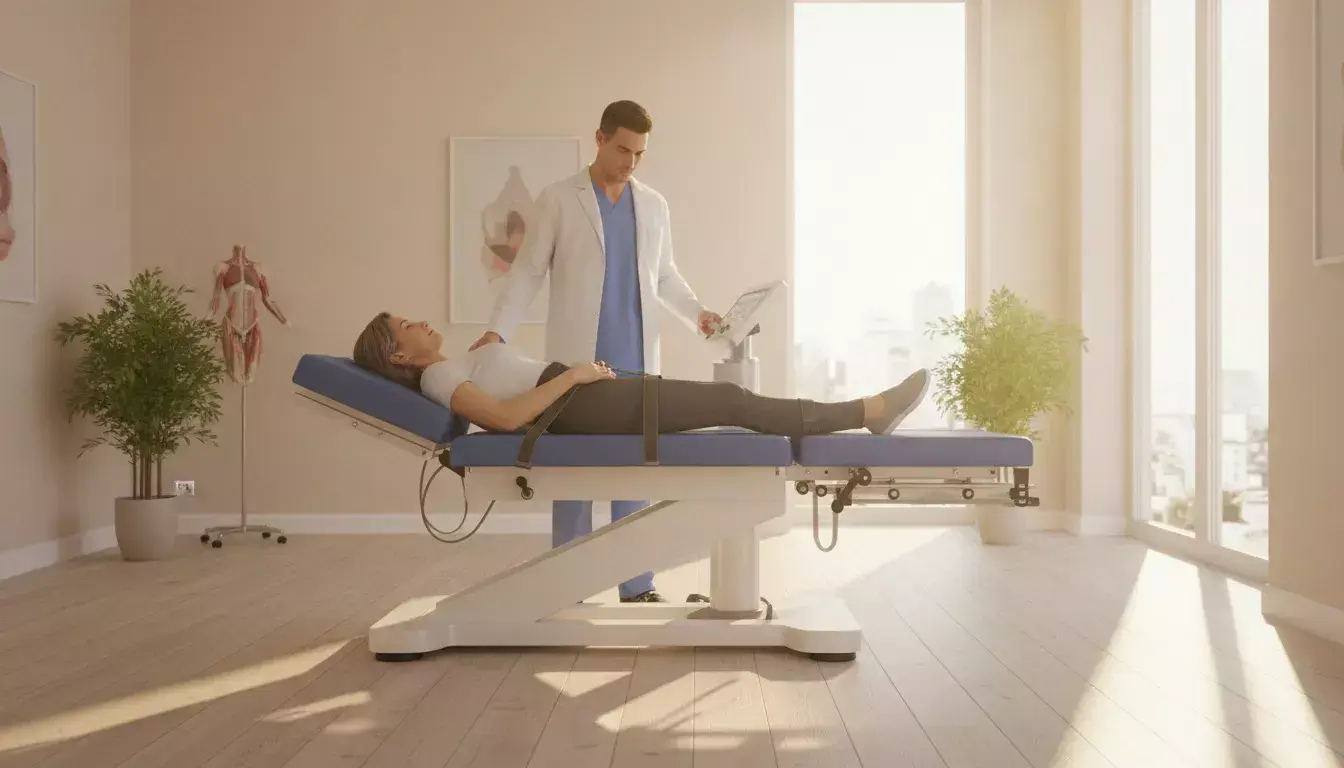
During a session, you remain fully clothed and lie on a motorized traction table. The table moves in carefully controlled cycles that lengthen and relax the spine. This alternating motion can create a temporary reduction in pressure within and around the discs, sometimes described as negative pressure. That pressure change may help reduce the mechanical load affecting a disc or nerve. Baylor Scott & White describes nonsurgical spinal decompression as a conservative therapy that uses traction to stretch the spine and relieve pressure on spinal structures. Read the clinical overview from Baylor Scott & White.
The process is not a forceful adjustment. Your provider selects the settings based on your symptoms, physical findings, and treatment goals, then monitors how your body responds. Many people describe the movement as a gentle pulling or lengthening sensation. The table's design allows you to stay relaxed, and the treatment should not require anesthesia, an incision, or a hospital stay.
Why reducing pressure matters
When a disc or surrounding tissue is irritated, ordinary activities such as sitting, walking, bending, or exercising may become more difficult. Reducing the demands placed on sensitive structures can be one part of a broader conservative care plan. It does not promise to reverse degeneration or guarantee a particular result. Instead, it gives your provider a non-surgical tool for managing symptoms and supporting better movement when it is appropriate for your condition.
Spinal decompression is not automatically right for everyone. A clinical evaluation helps determine whether the approach fits your symptoms, health history, and imaging findings. If it may be appropriate, your provider can explain how non-surgical spinal decompression in Atlanta could fit into a personalized plan.
Conditions Spinal Decompression Therapy Can Help
When back or neck symptoms begin to limit your routine, the first step is understanding what may be contributing to them. Spinal decompression therapy is often considered for several disc- and nerve-related conditions, including herniated discs, bulging discs, degenerative disc disease, sciatica, and chronic lower back or neck pain. A clinical evaluation helps determine whether reducing pressure around the spine is a reasonable part of your care plan.
Disc-Related Pain
A herniated or bulging disc can irritate nearby structures and contribute to localized soreness, stiffness, or symptoms that travel into an arm or leg. Degenerative disc disease describes age-related changes in the discs, which can reduce their ability to cushion movement and may make sitting, bending, or standing less comfortable. Decompression uses controlled traction to gently lengthen the spine and reduce pressure on spinal structures. It does not reverse degeneration or guarantee a particular outcome, but it may support a conservative plan focused on improved comfort and function.
Patients with chronic lower back or neck pain may also explore this approach when symptoms continue despite rest, activity changes, or other conservative measures. The goal is not to assume that every symptom has the same cause. Imaging and examination can help clarify whether disc involvement, nerve irritation, instability, or another issue is present.
Understanding Sciatica
Sciatica refers to symptoms affecting the sciatic nerve, often felt as pain, tingling, numbness. Or weakness that travels from the lower back through the buttock and into the leg. When a disc or another spinal structure contributes to nerve pressure, decompression may be considered as one way to reduce that mechanical stress. Because radiating symptoms can have different causes, proper screening matters before treatment begins.
WebMD lists these disc, nerve, and chronic pain conditions among the situations in which nonsurgical spinal decompression is often used. Review the medical overview of spinal decompression therapy, then discuss your symptoms and imaging with a qualified provider to determine whether non-surgical spinal decompression in Atlanta fits your needs.
Spinal Decompression Therapy vs Surgery: Choosing Non-Surgical First
When back or neck symptoms begin affecting work, exercise, or sleep, it is reasonable to ask whether surgery is necessary. In many cases, the decision is better understood as a continuum rather than a choice between two competing treatments. A conservative approach may be considered first when the evaluation suggests that symptoms can be managed without an operation. Surgery remains an important option when a condition is severe, persistent, or does not improve with appropriate conservative care.
| Consideration | Non-surgical spinal decompression | Spinal surgery |
|---|---|---|
| Invasiveness | Non-invasive treatment using controlled motorized traction to gently stretch the spine and reduce pressure on spinal structures. | An operative procedure that may involve incisions and surgical correction of a specific spinal problem. |
| Anesthesia | Does not typically require surgical anesthesia. | Usually requires anesthesia and an operating-room setting, based on the procedure and the patient's medical needs. |
| Recovery time | Generally allows patients to leave after a session and continue a clinician-directed plan without surgical recovery. | Recovery varies by procedure and individual health. It may include activity restrictions, rehabilitation, and follow-up care. |
| Typical candidates | Patients whose evaluation supports trying conservative care and who do not have findings requiring urgent surgical management. | Patients with severe or persistent conditions, or symptoms that have not responded adequately to conservative therapies. |
| Cost profile | Often involves a series of scheduled visits. Coverage and out-of-pocket costs vary by plan and provider. | May include facility, anesthesia, surgeon, imaging, rehabilitation, and follow-up costs. The total varies substantially by procedure and coverage. |
| When recommended | When a non-surgical plan is clinically appropriate and the goal is to support mobility and function while reducing pressure on affected structures. | When a specialist determines that the severity, persistence, or progression of the condition warrants an operation. |
Why conservative care may come first
Spinal decompression therapy uses traction, not an incision, to create carefully controlled movement through the spine. It may be one part of a broader plan that includes movement guidance, strengthening, and other clinician-recommended care. It is not appropriate for every patient, and an evaluation should guide the decision rather than a treatment label alone. A clinician may review symptoms, medical history, and imaging before recommending a protocol.
According to Baylor Scott & White Health, spinal decompression surgery is generally considered for severe or persistent conditions after conservative therapies have not provided enough benefit. That does not make surgery a failure, or non-surgical care a guarantee. It means the appropriate next step depends on the findings, the symptoms, and how the body responds over time.
For patients in Atlanta exploring a non-surgical first approach, learn more about non-surgical spinal decompression in Atlanta and discuss whether an evaluation is appropriate for your situation.
What to Expect From Your Spinal Decompression Treatment Plan
A clear plan helps you know what will happen at each stage and gives your provider a way to tailor care to your goals. Health history, and imaging findings. Spinal decompression therapy is not a one-size-fits-all appointment. Your clinician will review your information, explain the reasoning behind the recommended schedule, and adjust the plan as your response becomes clearer.
-
Begin with an evaluation and health history
Your first visit typically starts with a conversation about your symptoms, daily activities, previous injuries, medical conditions, and treatments you have already tried. Your provider may also assess posture, movement, flexibility, and areas of sensitivity. This evaluation is an opportunity to describe what you want to return to, whether that means walking comfortably, exercising, working, or keeping up with family and community activities. The information helps determine whether decompression belongs in your care plan and whether another approach may be more appropriate.
-
Complete imaging-based screening when appropriate
MRI or X-ray imaging may be used to evaluate candidacy. These images can help your provider review joint spacing, spinal stability, structural changes, and the grade of any degenerative findings. Imaging is not a promise that treatment will produce a particular result. It is one part of a careful screening process, and not everyone is a candidate. Your provider should explain what the images show and how they affect the recommendation before care begins.
-
Attend a gentle, guided treatment session
During a typical session, you remain fully clothed while lying on a computer-controlled table. The table applies carefully measured pull-and-release cycles rather than one sustained force. Many sessions last about 30 to 45 minutes, according to WebMD's overview of spinal decompression therapy. Your provider can answer questions during the appointment and adjust positioning or settings for comfort.
-
Follow the recommended course of visits
One appointment is not always enough to evaluate how your body responds. A commonly cited schedule is 20 to 28 treatments over five to seven weeks, although your actual plan may differ based on your evaluation and goals. Consistency matters because a planned course gives your provider enough information to assess progress instead of judging the approach from a single visit.
-
Reassess progress and refine the plan
Periodic reassessment helps connect the treatment plan to real-life changes. Your provider may ask about comfort, movement, sleep, activity tolerance, and any new symptoms. Based on that discussion, the plan may continue, change, or shift toward another conservative option. The goal is informed care that stays responsive to you, not an automatic schedule that continues without review.
Is Spinal Decompression Therapy Right for You?
Spinal decompression therapy may be worth considering if you are looking for a non-surgical option, but it is not appropriate for every person or every spinal condition. A thoughtful evaluation should come before any treatment plan. The goal is to understand what is contributing to your symptoms and whether reducing pressure around the discs and nerves fits your needs.
Who may be a candidate?
People who may benefit from an evaluation often include adults with disc-related pain, sciatica, chronic low back pain, or ongoing neck discomfort. A herniated or bulging disc can affect nearby nerves, while sciatica describes pain or other symptoms that travel along the sciatic nerve. These concerns can affect walking, exercise, sleep, and the active lifestyle many Atlanta residents want to maintain.
Being interested in a non-surgical approach does not automatically make someone a candidate. Your provider will consider the pattern and duration of your symptoms, your medical history, prior injuries or procedures. And how you responded to conservative care such as activity changes, physical therapy, or other non-invasive treatments.
Why imaging and history matter
Screening commonly includes an MRI and/or X-ray evaluation of the spine. Imaging can help a provider assess the condition of the discs and surrounding structures, along with joint space, instability, deformities, and the grade of any arthritis. Your symptoms and examination findings need to make sense alongside those images. This process helps identify people who may be better suited to another form of care or who need additional medical evaluation first.
If your history, examination, and imaging suggest that decompression may be reasonable, your provider can explain the expected goals, limitations, and alternatives before you decide. You can learn more about non-surgical spinal decompression in Atlanta and use that information to prepare questions for a consultation. Patient selection should guide the protocol, not a one-size-fits-all promise.
Why Atlanta Residents Are Choosing Non-Surgical Back Pain Care
For many adults in their 40s, 50s, and 60s, staying active is part of life in greater Atlanta. A long commute, a round of golf, a tennis match, a hike through local trails, or time playing with grandchildren can all make it important to keep moving. When back discomfort begins limiting those routines, surgery may feel like an oversized first step. Non-surgical care offers another path to explore with a qualified clinician.
Chiropractor-led care can fit more easily into a busy schedule because it is designed around conservative treatment and gradual progress rather than a lengthy surgical recovery. An evaluation helps clarify whether spinal decompression therapy is appropriate, what may be contributing to symptoms, and whether imaging is needed before a treatment plan is recommended. Not everyone is a candidate, and a careful screening process matters.
Care that supports an active routine
Spinal decompression can be one part of a broader plan. Depending on a patient's needs, care may include chiropractic adjustments, movement guidance, and other supportive therapies. The goal is not to promise a cure or guarantee a specific result. It is to create a thoughtful, individualized strategy that may help reduce pressure around affected discs or nerves while supporting comfortable movement and daily function.
This continuum can be especially helpful for Atlanta residents who want to stay engaged with work, family, and recreational activities while considering their options. Some patients may also discuss complementary regenerative treatments with their provider when those approaches are clinically appropriate. Each modality has a distinct purpose, so the treatment plan should be based on the patient's history, examination, imaging, and goals rather than a one-size-fits-all protocol.
To explore the local approach in more detail, read the spinal decompression chiropractor guide. You can also learn about combining spinal decompression with shockwave therapy when discussing possible supportive options with your care team.
For an overview of the clinic's service, visit non-surgical spinal decompression in Atlanta. A consultation can help you understand whether this conservative direction fits your condition and your plans for staying active.
Frequently Asked Questions
Does spinal decompression actually work?
Results vary because the underlying condition, imaging findings, and overall treatment plan differ from person to person. Spinal decompression may help some patients manage back or neck symptoms, but it is not a guaranteed cure or a way to reverse structural changes. A clinical evaluation helps determine whether controlled traction is a reasonable conservative option for your goals.
What conditions can spinal decompression therapy address?
It is commonly considered for herniated or bulging discs, degenerative disc disease, sciatica, and chronic lower back or neck pain. These conditions are not interchangeable, so the treatment plan should reflect your symptoms and screening results. Preferred Regen ATL uses MRI and/or X-ray findings when evaluating joint space, instability, deformities, and the grade of arthritis or other spinal concerns.
How is non-surgical decompression different from spinal surgery?
Non-surgical decompression uses controlled traction without an operation. While surgery is a more advanced option generally considered for severe or persistent conditions that have not responded to conservative care. Baylor Scott & White Health describes surgery as an option for severe or persistent conditions. Your clinician can explain which level of care fits your findings and medical history.
How many sessions might I need?
A commonly referenced course includes sessions lasting about 30 to 45 minutes, with 20 to 28 treatments over five to seven weeks, although your plan may differ. WebMD reports these typical treatment ranges. Reassessment during the course helps determine whether continuing, adjusting, or changing the approach makes sense.
Ready to Explore Non-Surgical Back Pain Care?
Understanding whether spinal decompression therapy fits your needs starts with a personalized consultation and appropriate screening. A conversation with the Preferred Regen ATL team can help you review your options and decide whether this conservative approach is reasonable for your goals. Call 404-888-0666 or schedule a consultation about non-surgical spinal decompression in Atlanta to take the next step.

Lindsay GoMega
Contact Me