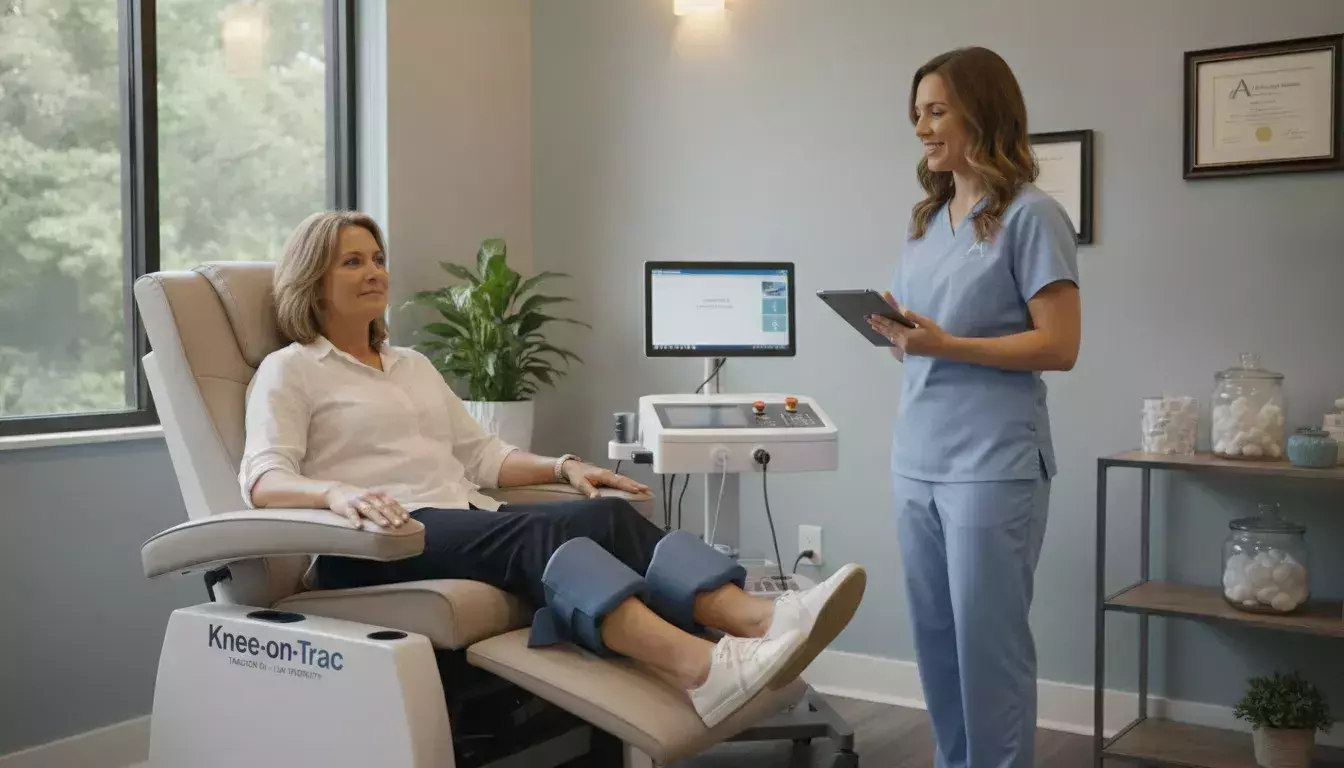
chair while your leg is positioned in the device. Sessions typically last 20 to 30 minutes, during which you will feel a gentle, rhythmic pulling sensation as the machine cycles through stretching and relaxing the joint. There is no pain involved, and most patients find the process quite relaxing. Because the treatment is completely non-invasive, there is zero downtime afterward. You can drive yourself home or return to work immediately after your session.
How Does Knee Osteoarthritis Develop?
Osteoarthritis is the most common form of arthritis, affecting more than 32.5 million adults in the United States. In a healthy knee, a smooth layer of cartilage covers the ends of the bones, acting as a cushion that allows the joint to move without friction. Over time, this protective tissue can break down, leading to the condition known as knee osteoarthritis.
Knee osteoarthritis develops when cartilage gradually wears away, causing bone-on-bone contact, inflammation, and pain. The breakdown reduces joint space and impairs nutrient flow to the remaining cartilage.
The breakdown of joint cartilage
The process often begins with microscopic cracks in the cartilage surface. As these fissures expand, the once-smooth surface becomes rough and thin. Without adequate padding, the bones may begin to rub against one another, producing the pain, stiffness, and swelling that characterize osteoarthritis. While this deterioration occurs gradually over years, it can eventually make everyday activities like walking or climbing stairs significantly more difficult.
The role of synovial fluid
Your knee joint contains synovial fluid, a thick substance that performs two essential functions: it lubricates the joint and transports nutrients to the cartilage. Because cartilage has no direct blood supply, it relies entirely on this fluid to stay healthy. In an arthritic knee, the synovial fluid often becomes thinner and less effective. When the joint loses its natural lubrication, cartilage breakdown accelerates, creating a downward spiral that intensifies symptoms over time.
Pressure and joint health
As cartilage deteriorates, the body responds with inflammation, which often increases pain. Pressure inside the joint rises, making it even harder for fresh nutrient-rich fluid to reach the cartilage. This self-reinforcing cycle of pressure and breakdown is why many patients begin searching for a non-surgical guide to managing arthritis. Reducing intra-articular pressure is often the first step toward allowing the knee to begin functioning more naturally.
Can Knee-on-Trac Truly Relieve Osteoarthritis Pain?
Osteoarthritis causes the cartilage in your knee to wear down over time, leading to a loss of cushioning between the bones. The Knee-on-Trac system uses gentle, sustained distraction to address this mechanical problem directly. By carefully pulling the joint surfaces apart, it creates space, reduces pressure, and allows the knee to move with less discomfort.
Knee-on-Trac relieves osteoarthritis pain by gently distracting the joint, creating a vacuum effect that draws nutrient-rich fluid into the cartilage, reducing pressure and inflammation with each session..
The vacuum effect for joint health
When the device gently distracts the knee joint, it generates negative pressure within the capsule. This vacuum effect pulls synovial fluid into the joint space, delivering the oxygen and nutrients that cartilage needs to maintain its structure. By restoring this natural exchange, the therapy helps slow the degenerative process and supports the knee's own healing mechanisms.
Reducing pressure and inflammation
Elevated pressure inside the knee joint is a primary driver of osteoarthritis pain. Knee-on-Trac directly reduces this pressure, allowing the joint to move more freely without the grinding sensation that characterizes advanced arthritis. Many patients report noticeable improvements in their range of motion after just a few sessions. Lower intra-articular pressure also helps control inflammation. By relieving the mechanical stress on joint structures, the body can manage swelling more effectively, leading to a more comfortable and functional knee.
Clinical evidence for knee decompression
Research supports the use of mechanical decompression for knee osteoarthritis. Clinical studies have documented significant reductions in both pain intensity and frequency among patients who complete a full course of decompression therapy. These findings align with what our team at Preferred Regen ATL observes regularly. Patients who combine knee decompression therapy with regenerative treatments often achieve better outcomes. The decompressed joint provides an optimal environment for healing. Research has also shown that biologic knee injections tend to produce stronger results when the joint is first prepared through decompression.
What a Typical Knee-on-Trac Treatment Plan Looks Like
Starting a new treatment plan can feel like a significant decision. At Preferred Regen ATL, we have designed our knee decompression program to be straightforward and patient-friendly Most people want to know how long the process takes, what each visit involves, and when they can expect to feel results.
A standard Knee-on-Trac treatment plan involves 8 to 12 sessions over 4 to 6 weeks, with each session lasting 20 to 30 minutes. Patients experience no downtime and can resume normal activities immediately.
Your first visit and assessment
Your journey begins with a comprehensive evaluation. Our team reviews your medical history and performs a physical examination to identify the source of your knee pain. We assess joint mobility, check for signs of joint space narrowing, and review any available imaging such as X-rays or MRI results. This evaluation helps us determine whether Knee-on-Trac is appropriate for your specific condition. If your knee pain stems from osteoarthritis, a meniscus tear, or general joint stiffness, we can design a customized plan tailored to your needs.
The session experience
A typical treatment session is relaxed and takes about 20 to 30 minutes. You sit comfortably while the device applies gentle, rhythmic traction to your knee joint. This controlled force creates the vacuum effect that supports joint healing. There is no pain and no recovery time required. Most patients find the process soothing. Because it is a completely non-invasive treatment, you can drive yourself home and continue your daily routine immediately after each appointment.
Timeline and recovery steps
- Initial plan setup. We design a course of 8 to 12 visits over 4 to 6 weeks based on your specific condition and goals.
- The decompression phase. You attend regular sessions where the device uses controlled distraction to improve joint space and fluid circulation.
- Complementary therapies. We often incorporate treatments such as cold laser or shockwave therapy to enhance your body's healing response.
- Regenerative support. For optimal results, we may recommend PRP or biologic injections to support tissue recovery within the decompressed joint.
- Progress monitoring. Our team tracks your response to treatment at regular intervals, adjusting the plan as needed to ensure you are meeting your mobility and pain-relief goals.
Working with other therapies
Knee-on-Trac is effective on its own, but it delivers even stronger results when integrated into a comprehensive treatment approach. At our clinic, we design multi-modal plans that address every aspect of your recovery. This may include shockwave therapy to manage inflammation or PRP injections to amplify your body's natural repair processes. The Centers for Disease Control and Prevention reports that millions of adults experience chronic knee pain. Combining multiple therapeutic tools gives these patients the best opportunity to avoid surgery and maintain an active lifestyle.
Who Makes a Good Candidate for Knee Decompression Therapy?
Non-surgical knee decompression is an excellent option for many individuals dealing with chronic knee pain. It works particularly well for those with mild to moderate joint degeneration who want to avoid more invasive procedures. The treatment uses controlled, gentle force to stretch the knee joint, which can provide lasting relief from daily stiffness and discomfort.
Ideal candidates for knee decompression include adults with mild to moderate osteoarthritis, meniscus tears, or chronic stiffness who want to avoid surgery. Patients are evaluated through physical exam and imaging to confirm suitability.
People with chronic joint issues
The most common candidates for this type of knee therapy are adults living with osteoarthritis. This condition affects more than 32 million people nationwide according to the CDC. Patients between the ages of 50 and 65 often respond particularly well, using decompression to slow joint degeneration and maintain mobility. The therapy is also appropriate for individuals with meniscus tears or patellar tendon issues who have not found relief through rest or conservative measures.
Ligament strains involving the MCL or LCL can also benefit from this approach. Decompression promotes blood flow to the affected area, supporting natural healing. It is also helpful for patients with a Baker's cyst, as reducing joint pressure often decreases the fluid buildup behind the knee. By taking mechanical load off the joint structures, we help these tissues recover without surgical intervention.
Active adults with sports injuries
Younger adults between 35 and 50 frequently seek knee decompression for sports-related injuries. If you are an active individual who needs to return to your routine quickly, this therapy can accelerate your recovery. It is also commonly used as part of a post-surgical rehabilitation program to restore mobility. We often pair it with other regenerative medicine treatments to help the body repair itself more efficiently.
Knee Treatment Options at a Glance
| Treatment | Invasive? | Downtime | Best For | Works With Knee-on-Trac? |
|---|---|---|---|---|
| Knee-on-Trac Decompression. | No. | None. | Mild to moderate OA, meniscus tears. | Primary therapy. |
| Physical Therapy. | No. | None. | Muscle weakness, rehab after injury. | Yes. |
| Corticosteroid Injections. | Minimal. | 1-2 days. | Acute flare-ups, short-term relief. | Yes. |
| PRP or Biologic Injections. | Minimal. | 1-2 days. | Tissue repair, cartilage support. | Yes. |
| Knee Replacement Surgery. | Yes. | 6-12 weeks. | Severe bone-on-bone OA. | No. |
When other care is needed
While decompression is highly effective, it may not be sufficient as a standalone treatment for every patient. Individuals with advanced joint damage where bone rubs against bone may see limited results from decompression alone. In these cases, we recommend a multi-step treatment strategy. For example, some patients achieve better outcomes when they combine decompression with exosome therapy for arthritis. This combination creates joint space while simultaneously providing the cellular support needed for tissue repair.
- Patients who want to avoid or delay total knee replacement.
- Individuals who have not found relief through physical therapy or medication.
- Those whose knee stiffness worsens after prolonged sitting or sleeping.
- People with meniscus injuries seeking a non-surgical treatment path.
Why Choose Preferred Regen ATL for Knee-on-Trac in Atlanta
When exploring knee decompression options, the experience of the provider matters as much as the technology itself. Preferred Regen ATL has been serving the Atlanta area since 2003, bringing over two decades of experience in non-surgical joint care. Our clinic is located at 650 Hamilton Ave. SE, Suite C, Atlanta, GA 30312, where we help patients avoid major surgery through advanced regenerative and decompression therapies.
Preferred Regen ATL offers Knee-on-Trac as part of a comprehensive non-surgical treatment approach. With over 60 treatment modalities, eight providers, and 22 years of experience serving the Atlanta community.
A team of skilled experts
Our clinic includes eight healthcare providers who collaborate on each patient's treatment plan. The team includes Dr. Audra Moran, Josh Norman PA-C, and Dr. Cody Webb, among others. We do not simply treat your knee pain in isolation. Instead, we evaluate how your joint health affects your daily life and activities. This multidisciplinary approach allows us to deliver a level of comprehensive care that smaller clinics may not be able to match.
The most comprehensive care in Atlanta
We are one of the few clinics in Atlanta offering more than 60 treatment modalities across six specialty areas under one roof. While many clinics focus on a single approach, we design fully integrated treatment plans. This means we can combine Knee-on-Trac with regenerative medicine therapies to optimize your body's healing capacity. We frequently pair decompression with PRP or biologic injections to achieve the best possible outcomes for our patients.
Treatment plans that work together
Knee-on-Trac delivers its best results as part of a thoughtfully designed, multi-modal treatment plan. At our clinic, you may also receive shockwave therapy, cold laser, or manual joint mobilization to support your recovery. By addressing both the local knee mechanics and the body's systemic healing capacity, we help you regain mobility without the need for joint replacement surgery.
The Centers for Disease Control and Prevention (CDC) reports that arthritis affects over 32.5 million adults in the United States. Many of these individuals believe that major surgery is their only option. Our approach offers a genuine alternative. Our treatment plans are designed to reduce pain, restore fluid dynamics within the joint, and improve quality of life through safe, non-surgical methods.
Frequently Asked Questions
Is non-surgical knee decompression painful?
No, most patients do not find this therapy painful. The system uses a gentle, rhythmic force to stretch the knee joint gradually. You may feel a light pulling sensation during the session, but it is typically described as relaxing rather than uncomfortable. Many patients at Preferred Regen ATL appreciate that there are no needles or surgical incisions involved.
How many knee decompression sessions will I need?
Most patients require between 12 and 18 sessions to achieve optimal results. We typically schedule these visits over a period of four to six weeks, allowing your body to respond and adapt to the treatment. Our team monitors your progress throughout the process and adjusts the plan as needed to ensure you are getting the maximum benefit from each session.
Does knee decompression have side effects?
Most patients experience no side effects from this therapy. Because the treatment is non-surgical, there are no needles, incisions, or medications involved. You might feel a mild stretching sensation in the knee during or after a session, which is a normal response to the mechanical distraction. It is a safe option for individuals looking to avoid the risks of surgery or the side effects of long-term pain medication.
What makes Knee-on-Trac different from regular knee traction?
Knee-on-Trac is significantly more advanced than basic traction devices. While traditional traction simply pulls on the leg in a single direction, Knee-on-Trac combines three distinct actions: distraction, mobilization, and oscillation. This multi-axial approach more effectively targets the mechanical sources of knee pain.
Can I combine Knee-on-Trac with other treatments at Preferred Regen ATL?
Yes, combining Knee-on-Trac with other treatments is a common and highly effective approach. Many patients see better results when decompression is paired with PRP injections, shockwave therapy, or cold laser. The decompressed joint provides an optimal environment for these therapies to work. Our team designs fully integrated treatment plans that address every aspect of your knee health.
What makes Knee-on-Trac different from regular knee traction?
Knee-on-Trac is a device engineered specifically for the knee joint. Traditional traction machines use a one-size-fits-all approach, but Knee-on-Trac combines traction with controlled mobilization to address the unique anatomy of the knee. This targeted approach opens the joint space more effectively and promotes nutrient flow into the cartilage in ways that standard traction cannot achieve.
Schedule Your Free Consultation in Atlanta
Delaying treatment for knee pain allows the underlying joint damage to progress. As cartilage continues to wear and inflammation persists, everyday activities like walking, climbing stairs, and standing for extended periods become increasingly difficult. Starting a knee decompression program now gives your body the best chance to heal and maintain function without the need for surgery. You can avoid months of recovery and return to the activities you enjoy by taking this step today.
Our team will evaluate your knee joint and help you determine the most effective treatment path. We combine Knee-on-Trac with our full range of decompression and regenerative services to create a personalized plan that addresses your specific needs. Do not let chronic knee pain hold you back when effective, non-surgical relief is within reach.
Ready to schedule a free consultation for non-surgical knee decompression? Call (404) 888-0666 to speak with our team today and start your path to pain-free movement.eam will evaluate your knee joint and help you determine the most effective treatment path. We combine Knee-on-Trac with our full range of decompression and regenerative services to create a personalized plan that addresses your specific needs. Do not let chronic knee pain hold you back when effective, non-surgical relief is within reach.
Ready to schedule a free consultation for non-surgical knee decompression? Call (404) 888-0666 to speak with our team today and start your path to pain-free movement.
Over thirty-two million Americans live with the stiff and painful joints caused by knee osteoarthritis. This condition can make walking through the grocery store or playing with grandchildren nearly impossible. Patients often feel stuck between managing pain with pills or facing a major surgical procedure.
Non-surgical knee decompression is a targeted therapy that gently creates space within the knee joint, reducing pressure on sensitive structures and cartilage. This process produces a vacuum effect that draws vital nutrients into the cartilage to support natural healing and improve range of motion. Many patients experience meaningful pain relief without the need for drugs or surgery.
Schedule a free consultation for non-surgical knee decompression in Atlanta and find out if you are a candidate.
If you want to find relief without the risks of surgery, you may want to learn more about how this technology works. Understanding the specific steps of the process can help you decide if it is right for your needs. We will start by answering the common question, What Is Knee-on-Trac Non-Surgical Knee Decompression? The path begins with
What Is Knee-on-Trac Non-Surgical Knee Decompression?
Lindsay GoMega
Contact Me